What you need to know before you walk into the meeting.
You’ve been asked to take the minutes.
Perhaps it’s tomorrow. Perhaps it’s in an hour. Nobody has shown you how to do it, and everyone else seems to assume you know what you’re doing.
The first thing to know is that you do not need to write down everything everyone says.
Your job is to produce a useful record of the meeting: what mattered, what was decided, what needs to happen next and who agreed to do it.
You can learn the finer points later. For your first meeting, concentrate on getting those things right.
If you want something to keep beside you while you’re in there, I’ve made a one-page First Minute-Taking Meeting Quick Reference. It covers what to check beforehand, what actually needs recording, what you can leave out, and a few phrases to use when you miss something. It’s a free PDF – no registration, no email address.
Download the First Minute-Taking Meeting Checklist
Get hold of the agenda
If there is an agenda, get a copy before the meeting. It gives you a ready-made structure for your notes and tells you what’s coming.
If previous minutes exist, glance at those too – not to memorise them, but to see how the organisation normally records things. Brief or detailed? Are speakers named? How are actions shown?
This also gives you an idea of the level of detail expected. Minutes for a weekly team meeting may look very different from minutes for a formal committee, board or HR meeting. You don’t need to solve that yourself if the organisation already has an established style.
If you’ve been given a template, use it. Your first meeting isn’t the time to redesign the organisation’s minute-taking process.
Know who is in the room
Names become surprisingly difficult when you’re also trying to follow a discussion. Get an attendee list if one exists, and find out who the unfamiliar faces are before the meeting starts.
This matters most when somebody agrees to an action. Writing “Finance to provide the revised figures by Friday” is useful. Writing “Someone to send figures” isn’t.
The same applies online. Don’t rely on the name displayed on screen – people join from shared rooms, use somebody else’s device, or appear as a phone number.
Don’t try to write everything down
This is the biggest trap for a first-time minute taker.
Someone starts speaking and you start typing. They keep speaking, so you keep typing. Then somebody interrupts, a third person answers, and while you’re still finishing the first sentence the chair announces a decision and moves on.
You’ve captured a lot of words and missed the most important bit.
Listen for the things that change something:
- A decision
- An action
- A deadline
- A responsibility
- A proposal that’s actually been agreed
- A point somebody would need later to understand the decision
You’ll still record discussion, but you don’t need every contribution to it – and you don’t need every disagreement either. If three people spend ten minutes debating Cardiff, Swansea, and going online before landing on Swansea, your minutes usually need the outcome and maybe why, not a replay of the argument.
The harder version of this: sometimes something important gets said but nothing is decided. Don’t invent an action or decision just to make your notes look complete. If the group agrees to come back to it next month, record that it was parked – not that it was resolved.
Your own notes don’t need to look like minutes while you’re writing them. Abbreviations, arrows, half-sentences are fine.
For example: Budget discussed – £5k increase – JS concerned re training – APPROVED – MK revised figures Fri
That’s not a finished minute. It doesn’t need to be. It’s enough to turn into one afterwards. Trying to compose polished sentences while the meeting is still happening uses attention you need for listening.
Record what happened, not what you think happened
This sounds like a small distinction, but it’s an important habit to get into from your first meeting.
If someone says a project is behind schedule, record the relevant point. Don’t add that the project is “badly managed” because that’s the impression you got from the discussion.
Likewise, somebody sounding annoyed doesn’t necessarily mean they formally objected to a decision.
Minutes aren’t the place for your interpretation of people’s motives, mood or intentions. If it matters, record what was actually said, decided or agreed.
Actions need more than an action
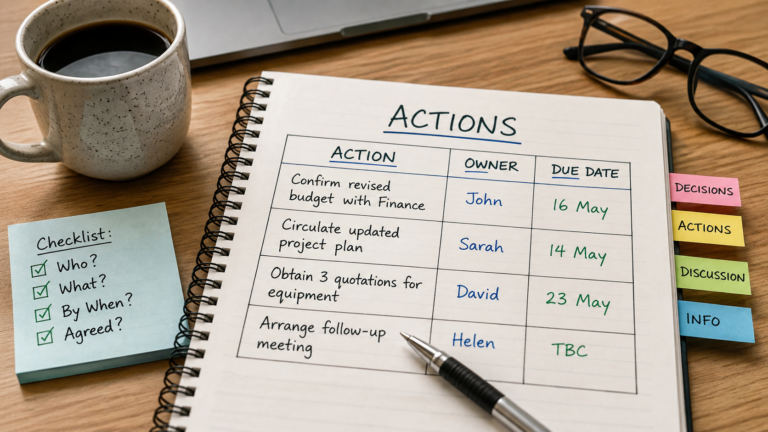
When somebody agrees to do something, try to capture three things: what, who, when.
Meetings are full of phrases like “we’ll sort that out” or “someone needs to speak to Finance.” Your notes need to get beyond that where possible. If you’re not sure who’s taken the action, that’s a perfectly reasonable thing to clarify.
If you miss something, ask
You will miss something. Experienced minute takers miss things too. Someone speaks quietly, two people talk at once, the chair moves through a decision faster than you expected.
Don’t sit there hoping you’ll remember it later. If it matters to the record, ask:
- “Sorry, could you repeat that last point before we move on?”
- “Just to confirm for the minutes, what was agreed there?”
- “Can I check who’s taking that action forward?”
A brief interruption during the meeting is usually easier than reconstructing a decision afterwards. Clarifying something important is part of doing the job properly – and if the chair asks “everyone happy with that?” and people just nod, take the few seconds you need to finish the note before the meeting moves on.
A recording is backup, not a substitute
If the meeting’s being recorded, or you’re allowed to record it yourself, that’s useful – but a one-hour meeting is still a one-hour recording. Good notes let you jump to the section you need rather than sitting through the whole thing again.
Never record without knowing you’re permitted to. Organisations often have rules about this, particularly where meetings touch personal or confidential information.
Don’t leave your notes for a week
The abbreviation that makes perfect sense at 11:15 on Tuesday can look mysterious by Friday afternoon.
Spend a few minutes on your notes soon after the meeting: fill in names, expand abbreviations, mark anything that needs checking, make sure the decisions and actions are identifiable. You don’t have to write the finished minutes immediately, but don’t let the context disappear from your head first.
And don’t panic if the write-up takes longer than the meeting itself. It usually does.
Your first draft doesn’t have to be perfect
Read it back as if you weren’t there.
- Would you understand what was decided?
- Can you identify every action and its owner?
- Have you recorded a suggestion as if it were a decision?
- Could three paragraphs of discussion be three sentences?
- Have you left out something needed to understand why a decision was made?
That’s a more useful check than worrying whether it sounds formal enough.
The basic mechanics of minute taking aren’t difficult to learn. The harder part is listening to a conversation while deciding, in real time, what deserves to become part of the record. That comes with experience.
For your first meeting: know what it’s about, know who’s there, listen for decisions and actions, ask when you need to, then turn your notes into the clean record afterwards.
That’s enough for meeting number one.
Good luck in there!
Erin
Taking Minutes for the First Time?
Keep the First Minute-Taking Meeting Checklist beside you during the meeting. It covers what to prepare, what to record, what you can leave out and what to say when you miss something.
Free PDF. No sign-up. No email address required.