Some meetings are simply harder to minute than others.
Sensitive HR meetings are a good example. Emotions can be running high. Someone may be angry, upset, embarrassed or worried about what happens next. There may be allegations, disagreements about what happened, personal information being discussed or conversations that are uncomfortable for everyone in the room.
And sitting quietly amongst all of that is somebody trying to create an accurate record.
That’s not always an easy job.
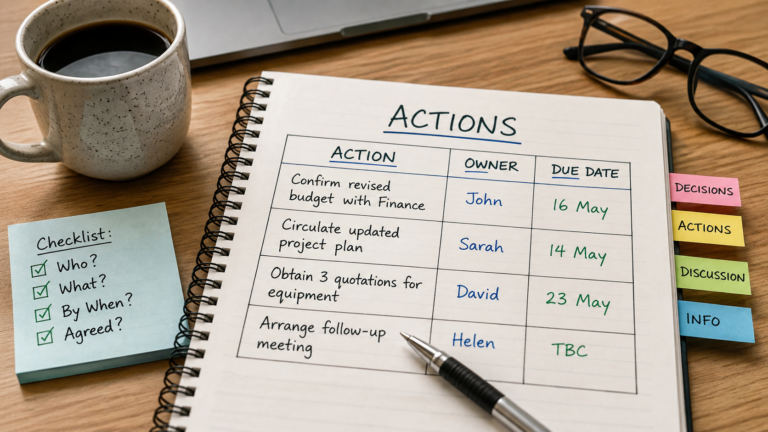
One thing that helps is not having to think about the shape of the document while you are in the room. I open the same minutes template for every meeting, sensitive ones included, so attendees, decisions and actions already have a place to go before anyone starts speaking.
Sensitive doesn’t necessarily mean disciplinary
It’s easy to hear “sensitive HR meeting” and immediately think of someone sitting across the table waiting to find out whether they’re going to lose their job.
It can be that serious, but it doesn’t have to be.
HR meetings can involve grievances, disciplinary matters, attendance, performance, relationships between colleagues, personal difficulties, substance misuse or concerns about someone’s behaviour.
The outcome might be serious. It might be relatively minor. It could result in support being offered rather than any formal action. Sometimes it will be a combination of things.
And the minute taker shouldn’t be trying to predict where the meeting is heading.
Their job is to record what actually happens.
That becomes particularly important when the people in the room have very different versions of events.
Neutral really does mean neutral
During a sensitive HR meeting, an employee says:
“I’ve told my manager about this three times and they’ve ignored me.”
The minutes are written as:
The employee told their manager about the issue three times and was ignored.
What’s the problem here?
At first glance, it looks perfectly reasonable. It’s concise, clear and appears to capture what was said.
But look at it again.
The employee didn’t provide the minute taker with an established fact. They provided their account of what happened.
By removing the attribution, the minutes have subtly changed the meaning. They now state that the manager was told three times and ignored the employee.
Compare that with:
The employee stated that they had raised the issue with their manager on three occasions and had received no response.
Now we’re recording something we know happened: the employee made that statement during the meeting.
We’re not deciding whether their account is correct.
And if the manager responds:
“That’s not true. This is the first I’ve heard about it.”
the same principle applies:
The manager stated that they had not previously been made aware of the issue.
The minutes now contain two conflicting accounts without the minute taker deciding which one is true.
Sometimes the actual words matter
Now consider another example.
During the meeting, the employee says:
“He’s lazy. He leaves everyone else to do his work.”
The minutes say:
The employee raised concerns about a colleague’s performance.
What’s the problem with that?
This time we’ve gone too far in the other direction.
In trying to make the minutes sound professional, we’ve sanitised what was actually said. If the language used is relevant to the meeting, the fact that the employee called their colleague “lazy” may matter.
A more accurate record might be:
The employee described their colleague as “lazy” and stated that other members of the team were being left to complete their work.
The quotation marks make it clear whose word “lazy” is. It isn’t the minute taker’s judgement.
And that’s the balancing act in sensitive meetings. Don’t turn someone’s account into fact, but don’t polish away important language either.
Sometimes you summarise. Sometimes you attribute. Sometimes you need the person’s actual words.
Knowing which is appropriate is part of the job.
Emotion changes the meeting
People don’t necessarily speak neatly when they’re upset.
Someone may talk quickly, repeat themselves or jump backwards and forwards through events. Another person may interrupt because they strongly disagree with what’s being said. Voices may be raised. Someone may become tearful. A break might be needed.
That creates a challenge for the minute taker.
The finished minutes still need to make sense to someone reading them afterwards, but they shouldn’t rewrite the meeting into the calm, orderly conversation everyone might wish had taken place.
If someone spends ten minutes repeating essentially the same point, the minutes don’t necessarily need ten minutes’ worth of text. The point can usually be recorded clearly once.
But if the person’s distress, reaction or the way something was said is relevant to what happened, removing it entirely could also give a misleading impression.
Again, judgement matters.
Don’t tidy the meeting into something it wasn’t
Turning a messy conversation into a clear written record is part of minute taking.
Rewriting history isn’t.
Suppose an employee gives one account of an incident and their manager gives another. Those accounts may be completely incompatible.
The minutes don’t need to resolve that disagreement.
In fact, trying to make the finished document flow beautifully can sometimes be the wrong instinct. Combining two conflicting accounts into one neat paragraph could accidentally suggest there was agreement where none existed.
The same applies to unanswered questions.
If somebody is asked a direct question and doesn’t answer it, don’t construct the minutes in a way that makes it appear that they did.
Clear minutes are good.
Artificially tidy minutes aren’t necessarily accurate minutes.
What should you leave out?
This is where “high-level minutes” can become surprisingly difficult.
Not every repeated sentence, hesitation, interruption or side comment belongs in the finished record.
But deciding what to leave out requires you to understand what matters.
A long discussion might eventually become a short paragraph in the minutes. That doesn’t mean the minute taker wasn’t listening to the rest of it. Quite the opposite. You need to understand the discussion before you can safely reduce it.
In a sensitive HR meeting, I’d be particularly wary of removing something simply because it feels uncomfortable or awkward.
The test isn’t whether a comment makes the minutes nicer to read.
It’s whether it matters to the record.
What about swearing, insults or threatening language?
There isn’t a sensible rule that says every swear word should be recorded verbatim.
Nor is there a sensible rule that says professional minutes should clean up everything unpleasant.
Context decides.
If someone swears in frustration while struggling to connect to a Teams meeting, the precise word probably isn’t the important part of the meeting.
If someone uses threatening, discriminatory or insulting language and that language is relevant to the matter being discussed, the actual words may be extremely important.
That’s when quotation marks become useful again.
They allow the minutes to preserve significant wording without appearing to adopt it.
The phrasebook has the lines I use for confidential and closed items, and for recording an account without endorsing it.
The minute taker isn’t endorsing the language.
They’re recording that it was used.
Getting the record right
Sensitive HR meetings can be uncomfortable, emotional and sometimes unpredictable. That doesn’t change the minute taker’s role, but it can make the judgement involved considerably harder.
The minutes shouldn’t decide who was right. They shouldn’t turn someone’s account into an established fact. And they shouldn’t tidy away significant words or disagreements simply because they make the finished document uncomfortable to read.
Sometimes the right approach is to summarise. Sometimes it’s important to make clear who stated what. And sometimes the actual words used need to be recorded verbatim.
The aim isn’t to reproduce the meeting word for word.
It’s to leave behind a clear, neutral and accurate record of what happened, including the difficult bits when they matter.
Start From a Template, Not a Blank Page
The meeting minutes template has attendees, decisions, actions with an owner and a deadline, and the next meeting date already laid out. One less thing to build while the meeting is happening.
Free Word document. No sign-up. No email address required.