Actions are often one of the most useful parts of a set of minutes. They are also surprisingly easy to get wrong.
In the meeting, everyone may understand what needs doing. A week later, an action such as “Finance issue to be sorted” isn’t much help to anybody.
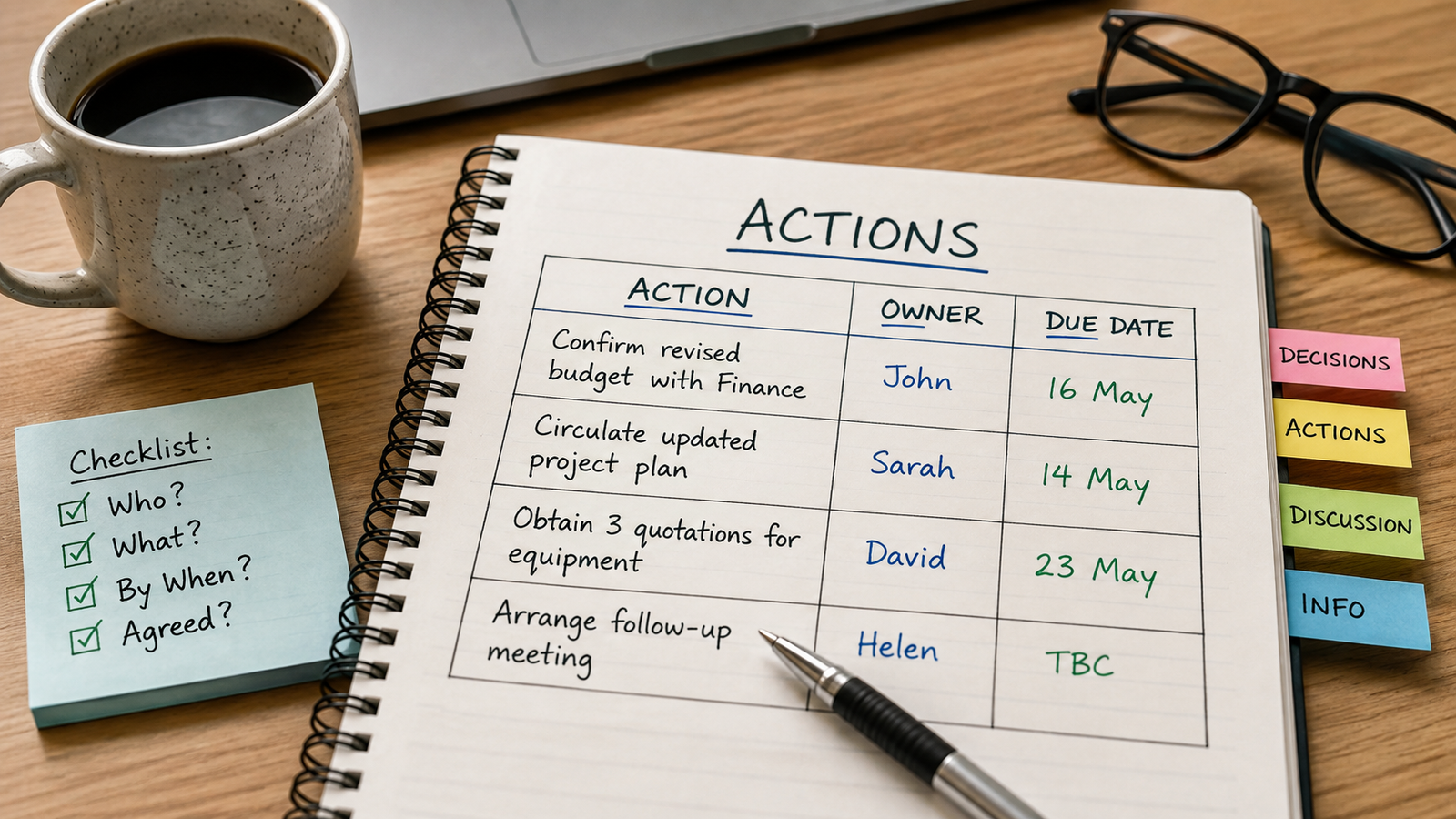
A useful action normally answers three simple questions: what needs to happen, who is responsible and, where one has been agreed, when it needs to be done.
The difficulty is getting that clarity without adding commitments that the meeting never actually made.
Capture the action when it happens
It is much easier to record an action accurately while the discussion is fresh than to reconstruct it afterwards.
When an action emerges, mark it clearly in your notes. Some minute takers use an A, a box, highlighting or a separate action column. The method doesn’t particularly matter as long as you can find actions quickly when you come to write the minutes.
If you’re taking minutes from a recording, a timestamp can also be useful when an action isn’t completely clear and you know you’ll want to revisit the discussion.
The important thing is not to rely on remembering later which of several suggestions eventually became the agreed action.
Be clear about what actually needs to happen
“John to speak to Finance” may identify an owner, but it doesn’t necessarily tell anyone what John is supposed to achieve.
Compare it with:
John to confirm the revised budget with Finance.
The second version tells John, the chair and anyone reviewing the actions later what the expected outcome is.
You don’t need to turn every action into a lengthy description. Usually a verb and a clear outcome are enough:
Sarah to circulate the revised policy.
David to obtain three quotations for the replacement equipment.
Helen to confirm the implementation date with the supplier.
Short can be perfectly clear.
Make sure somebody owns it
Meetings produce phrases such as “we need to look at that”, “someone should check” and “we’ll get that sorted” all the time.
They sound like actions, but nobody actually owns them.
If your role and the meeting allow it, this is often worth clarifying there and then. A simple question such as “Who should I put that action against?” can prevent uncertainty afterwards.
Sometimes the chair will do this automatically. A good chair will often summarise a discussion with something like, “Right, Sarah will check that with Finance and come back to us next week.”
That’s gold dust for the minute taker. The discussion has been converted into a clear action before the meeting moves on.
If nobody was given responsibility, be careful about choosing the person who seems most likely to own it when you write the minutes later. Being involved in the discussion doesn’t necessarily mean they accepted the action.
Record a deadline when there is one
An action with a deadline is generally more useful than one without it, but only if the deadline was actually agreed.
If the meeting agrees that something needs to be completed by Friday, record Friday.
If somebody says “as soon as possible”, don’t quietly turn that into Friday because Friday seems reasonable.
Where a deadline is important but hasn’t been specified, it may be worth clarifying it during the meeting:
“Is there a date for that action?”
There won’t always be one. Some actions genuinely don’t need a precise deadline, and organisational practice varies. The purpose is to record the commitment clearly, not to make every action fit the same template.
Don’t turn a possibility into an action
This is where a little care with wording matters.
The action wording that does hold up is in the phrasebook, along with what I write when the meeting names no owner at all.
Someone saying:
“I could probably get those figures by Friday.”
isn’t necessarily the same as the meeting agreeing:
Action: Sarah to provide the figures by Friday.
Likewise, “Perhaps John could speak to the supplier” may be a suggestion rather than an action assigned to John.
Meetings are full of ideas, suggestions and possibilities. Not all of them become commitments.
When writing the minutes, make sure the neat action you’ve created reflects what was actually agreed rather than what would have made sense to agree.
Watch out for the mysterious “we”
“We’ll contact the client.”
“We need to check the figures.”
“We’ll sort that before the next meeting.”
The people in the room may know perfectly well who “we” means. The person reading the minutes three weeks later may not.
Where ownership matters, a named person, team or role is more useful:
Customer Services to contact the client and confirm the revised arrangements.
It doesn’t always have to be an individual. An action may genuinely belong to Finance, HR, a project team or another group. What matters is that responsibility is clear enough for the action to be followed up.
Read actions back before the meeting ends
For meetings with several actions, a quick action summary at the end can be extremely useful.
It gives the chair and participants an opportunity to catch a misunderstanding while everyone is still there:
“Before we finish, I’ve got Sarah circulating the revised policy by Friday, Mark confirming the costs with Finance and Helen arranging the follow-up meeting. Is that correct?”
Whether the minute taker does this, the chair does it or it isn’t appropriate at all will depend on the meeting. But where it fits, it can save a surprising amount of clarification afterwards.
It also gives everyone the same understanding of what they’ve committed to.
Use an action log when the minutes aren’t enough
For regular meetings, projects or committees with actions that remain open between meetings, a separate action log can be more useful than expecting people to search through previous sets of minutes.
It can be very simple:
Action | Owner | Due date | Status
If you would like a starting point, the actions section of my free meeting minutes template uses the same idea: what needs to happen, who owns it and when it is due, one row each.
The minutes provide the record of how and why the action arose. The action log provides a practical way of following it through to completion.
At the next meeting, outstanding actions can then be reviewed without having to reconstruct them from several previous documents.
Before you finish the minutes, check the actions
A quick final review is worthwhile.
For each action, ask:
- Is it clear what needs to happen?
- Is responsibility clear?
- Have I included a deadline if one was agreed?
- Does the wording reflect what the meeting actually decided?
- Have I accidentally turned a suggestion into a commitment?
If you can answer those questions from the minutes, the person responsible for the action probably can too.
Clear actions make useful minutes
Recording actions isn’t about making them look tidy. It’s about making them useful after everyone has left the meeting.
A good action should allow someone to look at the minutes later and understand what needs doing, who owns it and when it is expected, without having to remember the original conversation.
Where the meeting itself hasn’t provided that clarity, clarification is usually better than filling in the gaps afterwards.
Start From a Template, Not a Blank Page
The meeting minutes template has attendees, decisions, actions with an owner and a deadline, and the next meeting date already laid out. One less thing to build while the meeting is happening.
Free Word document. No sign-up. No email address required.